SIGAU — Database Security & Administration on Azure SQL
University database-administration project: hardened SQL Server with Row-Level Security and Dynamic Data Masking, then migrated to Azure SQL Database.
Role: Team of 3 — my contribution: Row-Level Security, Dynamic Data Masking, SQL Server auditing, CIS hardening and the Azure SQL Database migration
Team
Team of 3
Timeline
Jun – Jul 2026
Type
Academic
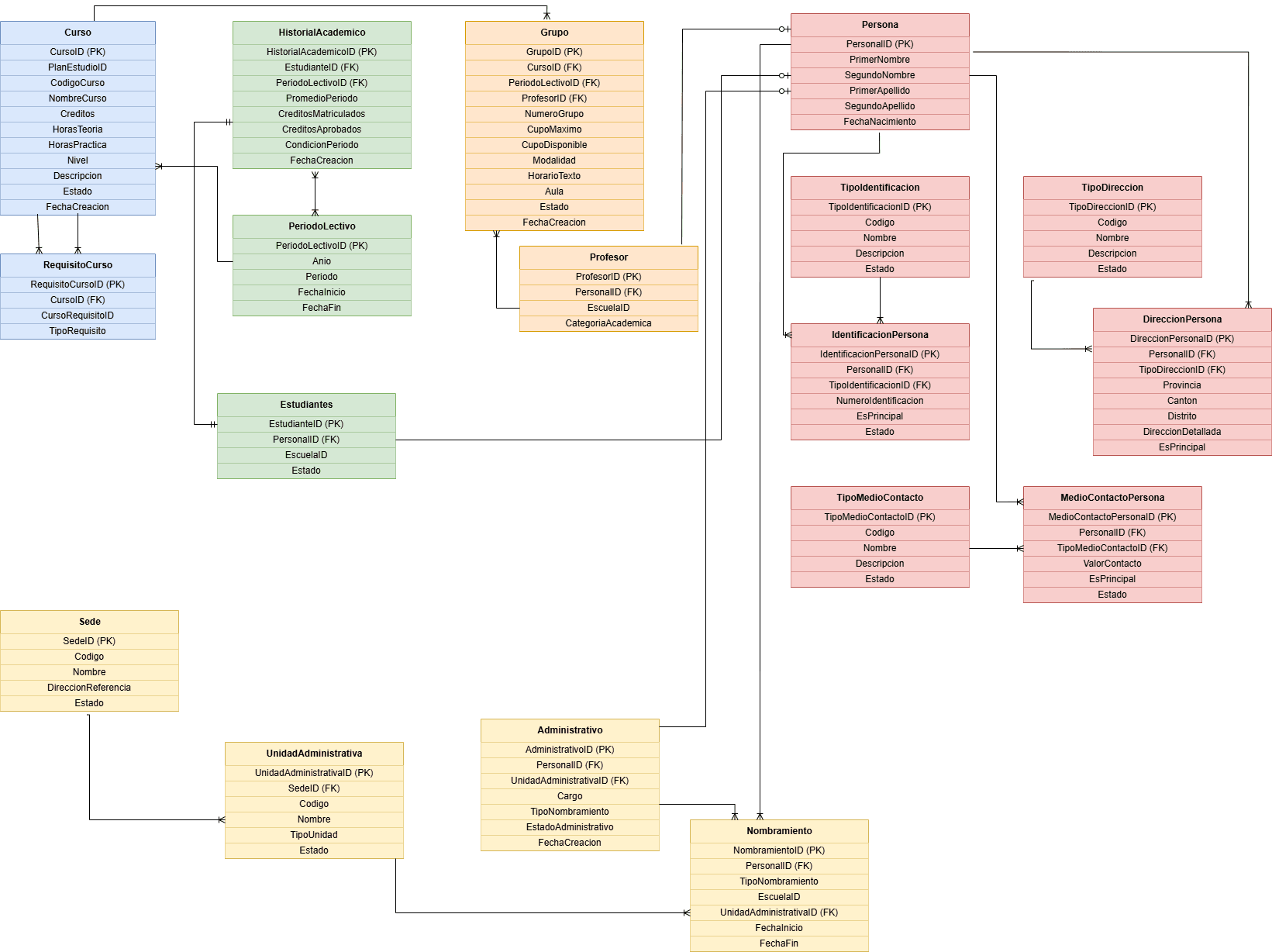
Data model
01 · Context & Problem
What problem this solves
IF-5100 Database Administration required a full 'secure ecosystem' around a self-selected data domain: a hardened OS and RDBMS with antimalware, a physical and logical data model with a simulated LUN layout, in-memory tables, Row-Level Security, Dynamic Data Masking, SQL Server auditing, a cloud/HA deployment, and three of SQL Server 2025's new features. My team modeled a university academic-management system (SIGAU) as the domain.
02 · Solution
What it actually does
SQL Server 2025 on a hardened Azure VM, later migrated to Azure SQL Database (PaaS), with a six-schema academic-management data model (people, academic operations, administration, security, external API calls, and a read-only view layer).
- Row-Level Security via real CREATE SECURITY POLICY filter predicates on two tables, scoping visibility by campus for seven test users.
- Dynamic Data Masking on four columns (national ID, contact email, two address fields), each with a masking function matched to its data type, and a dedicated role granted UNMASK.
- Server- and database-level SQL Server Audit covering SELECT/INSERT/UPDATE/DELETE and schema/permission changes, writing to rolling audit files.
- Transparent Data Encryption (AES-256) at the database level.
- A validated backup/restore cycle: full backup with checksum and compression, restored into a separate database and verified file by file.
- An In-Memory OLTP table with a hash index for a high-write access-log use case.
- SQL Server 2025's native VECTOR type and cosine VECTOR_DISTANCE search — explicitly documented as using manually assigned test vectors, not real embeddings.
- A real external REST API call via sp_invoke_external_rest_endpoint, with the response status code extracted from actual JSON, not hardcoded.
- Native REGEXP_LIKE check constraints validating email, national ID and student ID formats.
- Access control through 23 dedicated read-only views (one per table) and three database roles, with no direct SELECT grants on base tables.
03 · Architecture
Architecture & decisions
A simulated LUN layout across four Azure VM data disks (data files and the memory-optimized filegroup, transaction log, tempdb, and backups/audit, each on its own drive), five filegroups, and FULL recovery model.
Physical storage separated across drives to simulate a real LUN layout.
The assignment weighted physical data-architecture design at 30 of 100 points; this maps directly to how a real SAN-backed SQL Server deployment separates data, log, tempdb and backup I/O.
All reads forced through one view per table, with no direct grants on base tables.
Matches the assignment's explicit requirement and gives a single, auditable read surface per role.
The in-memory table was excluded from the Azure SQL Database migration.
Azure SQL Database's Basic tier doesn't support memory-optimized tables — an intentional, documented trade-off rather than an oversight.
04 · Stack
Full stack, by layer
Database
Infrastructure & Deploy
External Services
05 · Challenges
Technical challenges solved
CIS Benchmark hardening on two layers, with one honestly documented exception
Problem: Applying the CIS SQL Server and Windows Server benchmarks in full would have required a TLS certificate for forced encryption that wasn't available in the academic Azure environment.
Solution: Applied both benchmarks via six sequenced PowerShell scripts with a verification report, and explicitly documented ForceEncryption as left off, with the reason, instead of silently skipping it.
Migrating a fully on-prem-hardened database to a managed PaaS tier
Problem: Moving from a self-managed SQL Server VM to Azure SQL Database meant some features and objects weren't portable as-is.
Solution: Identified and removed an unsupported filegroup reference, excluded the memory-optimized table and its dependent view for the target tier, and verified post-migration object and row counts matched.
Implementing three genuinely new SQL Server 2025 features correctly
Problem: Vector search, external REST calls and advanced regex were all new to the team and easy to fake with cosmetic examples.
Solution: Implemented all three as real, executable T-SQL — native VECTOR_DISTANCE queries, a live REST call with real response parsing, and REGEXP_LIKE check constraints — while being explicit in the docs that the vector search uses test data, not real embeddings.
06 · Results
Results
Delivered a fully hardened, audited academic-management database with a validated backup/restore strategy and a real migration to a managed cloud database service.
No hard metrics confirmed yet for this project — the impact above is qualitative only.
07 · Retrospective
What I'd do differently
Figuring out what actually breaks when moving a fully hardened, on-prem SQL Server setup to a PaaS tier was the most useful part of the project — Azure SQL Database's Basic tier not supporting In-Memory OLTP meant that feature had to be deliberately dropped rather than assumed portable.
Have a system that needs building?
Tell me what you're running today and what's breaking. I'll tell you honestly whether I can help.